

Showing posts with label college. Show all posts
Showing posts with label college. Show all posts
Friday, July 8, 2016
Picture of an A*#hole
I hadn't submitted anything to a prestigious art show, so I was confused when someone claimed to see my work there. Read about it (here).

Wednesday, May 22, 2013
Pecan Perfection

I woke up this morning with a
hankering for pecan pie. Many of you probably have a special recipe for pecan
pie and I’m sure all have merit, but I’m just not interested. You see, I’ve
tasted nirvana and it isn’t to be found in fresh ingredients or recipes baked
with big doses of love. Nope, not what I’m salivating over.
Years ago Mrs. Chatterbox asked me what I
thought of pecan pie and, in a moment of weakness, I told her I liked pecan pie. This was a mistake because my wife will
do anything to please me, such as baking and serving me a perfect pecan pie,
but her efforts were doomed even before she started gathering together the
perfect ingredients. To be sure, Mrs. Chatterbox is a wonderful cook who’s
labored for forty years to keep me satisfied in the kitchen and elsewhere, but
when she presented me with her version of a perfect pecan pie I’m ashamed to
admit I was less than enthusiastic.
What was wrong with Mrs. C’s pie? For
starters, it was…rich and moist. Her crust was buttery and melted in my mouth,
a visual treat, rivulets dripping from the dollop of vanilla ice cream crowning
a generous slice. My wife’s pie
tasted like it was fresh from a bakery. It was ALL WRONG! I’d been spoiled by
the best.
It began when I was a UCLA student
motoring home to San Jose in my ’68 Beetle. I had a hideous case of the
munchies and pulled off the road in Bakersfield. After filling my tank with gas
I headed for a vending machine near the office. It was empty, except for one
package hanging in wait for someone to release it with a couple of quarters.
I wasn’t even sure what the item was; all I
could read was BAMA. But I was a starving college kid and I slipped two
quarters into the machine.
The package dropped; a mini cloud of dust
rose in the tray, making me wonder how long this item had failed to attract a
buyer. I claimed my prize and examined it carefully. The package was bright red
with Pecan written in festive letters,
and America’s Favorite on a blue
banner. I could barely make out a picture of the product partially hidden by
the letters, enough to make me wonder if I’d just wasted fifty cents. What I
saw resembled a circle of…cockroaches. How could this possibly be America’s
favorite?
I tore open the package and a pecan hockey
puck slid into my hand. I considered tossing it into a nearby trash can but my
pockets were empty, the vending machine was empty, and my growling stomach
convinced me to give this pie a chance. I bit into it and instantly noticed a
chewy sensation, followed by an explosion of taste that expanded in my mouth
until I was nearly overcome by tasty delight.
Over the next few years I made a point of
stopping at that gas station whenever I happened to be passing through
Bakersfield. Years have passed since I’ve driven through that part of the
country. I’ve appreciated many pecan pies over the years, including ones baked
in four star bakeries. Sadly, none have measured up to my vending machine
ideal. It goes without saying that my wife deserves a husband with a palette
far more sophisticated than mine. Unfortunately, we all have our limitations.
I understand the BAMA Corporation is still
in business, but I no longer see this product anywhere. If a store near you
carries them, make a chubby chatterbox extremely happy by mailing me a few of
these tasty treats.
Do you have a guilty pleasure?
Friday, November 16, 2012
A Brown Bear

When I graduated from college I
discovered that my art degree made me about as hirable as a shepherd. I finally
landed a job, but it was a disaster. Read about it here, and while you’re at it
I invite you to Join the new site.
Wednesday, June 20, 2012
Thirty Years In Waiting

Most people visiting our home don’t notice it, not that I’m surprised. I myself am inclined to disregard these unless they are on a wall in a doctor’s office, behind a surgeon discussing how he is going to slice me open. Then I check to be sure the document didn’t come from the Caribbean, embossed with a picture of Bob Marley. I’m talking about college diplomas.
I got to thinking about mine because a friend recently blogged that, while attending his graduation ceremony, he was surprised to receive an empty folder. His diploma had yet to be printed. He was unaware that colleges and universities pull this stunt as a precaution against students flunking their senior finals. My friend passed his finals with flying colors, and I hope he doesn’t have to wait long to receive his diploma. I waited thirty years for mine.
I graduated from UCLA on June 29, 1974. I didn’t attend my graduation ceremony because another event took precedence over my graduation; this was the day Mrs. Chatterbox and I were married, the only date available at the golf club where Mrs. C’s folks were members and where they wanted to hold our reception. Since UCLA was hundreds of miles south of San Mateo where we were to wed, and since I couldn’t be in two places at the same time, I was a no-show at my graduation.
To be honest, I never felt like I passed up much. Had I attended, I would have stood with thousands of others, waved my mortarboard cap for a minute or two and sat down. We graduates weren’t even going to be permitted to stroll across a stage. Besides, I was an art major and I figured (correctly as it turned out) that diplomas didn’t matter. Portfolios containing high quality art were all that galleries or advertising agencies cared about.
The decades came and went without me thinking much about my diploma, but after years of marriage the well of gift-giving ideas often runs dry. Mrs. C, who is one of the most generous people on Earth, was struggling to find a gift for my fiftieth birthday. Then an idea popped into her head.
So there I was on my fiftieth birthday, imagining myself as a tree and thinking about all those rings that would be visible if someone chopped me down, when my wife placed a package on my lap. It was shaped like artwork but she never bought me art, claiming it would be like bringing coals to Newcastle. I was baffled. I tore off the wrapping paper. In my hands, beautifully framed—my college diploma.
It was one of the few times in my life when I was speechless. “You ordered a copy of my diploma?” I asked.
“No,” she said. “That’s your actual diploma. I called UCLA about having a copy made and they said it wasn’t necessary. They had all unclaimed diplomas from the time the University opened in 1882. They were happy to mail me your diploma, and they didn’t even charge me anything.”
I studied the document carefully, noticing Governor Ronald Reagan’s signature on it, probably just a stamp but still cool. In beautiful calligraphy it proclaimed my bachelor’s degree in Painting, Sculpture and Graphic Arts. I overlooked the fact that over the years I’d lied shamelessly about my major to suit my purposes. If I was in a hot and heavy philosophical discussion with someone I’d fib and claim Philosophy was my college major. The same with Politics or History. Now it would be hard to lie about my major with this diploma hanging on the wall for all to see.
Just before beginning this post I was reading an article on Yahoo that listed the five most worthless college degrees. First and foremost was any degree having to do with Fine Arts. This might be the first time in my life I’ve figured at the top of any list. But worthless? Hardly. I may not have thought much of my diploma when I graduated, but thirty years later it hangs on my wall as a testament to my wife’s love and devotion.
Besides, the last time I was in the Caribbean I bought a few fake diplomas for twenty bucks. They look cheesy, having been printed in a rusty van by a Bob Marley look-a-like, but I’ve won a few arguments with them.
Friday, April 6, 2012
Whales And The "F" Word

It was an all-too-common situation; cocky college kid comes home eager to impress his blue collar parents with his newly acquired knowledge. The topic? Not politics or religion or social values. The topic was…whales. Dad was wise enough to rise from his chair and scurry from the kitchen before Mom and I drew our weapons. In my defense, I had no idea this topic would prompt a yelling match, or that I’d resort to yelling out the “F” word in our house for the first time.
It started out as a harmless comment. “We’ve been studying whales in my zoology class. They’re certainly incredible creatures.” This was back in the early Seventies when whales were being hunted to extinction.
Mom agreed. “They certainly are.” It wasn’t a given that she’d agree because Mom, to my shame, liked to broadcast that her Portuguese grandfather had been a whaler.
“We need to do all that we can to protect them,” I said.
She nodded, and pulled a drag on one of her Virginia Slims.
So we weren’t going to have an argument after all. Finally, we agreed on something. Mom and I had argued about everything under the sun, but here at last was something we could agree on. Her next statement was also something I could agree with. “The Japanese are the culprits. They’re the reason whales are going extinct.”
“The Japanese are certainly contributing to the problem.” I admitted.
“That’s because whale meat is the mainstay of the Japanese diet.”
I had to take issue with her on this one. “You’re right about Japan killing the most whales, but rice and fish are the mainstay of the Japanese diet.”
She looked down her sharp nose and said, “I don’t know what they’re teaching you at UCLA, but everybody knows Japanese people eat whale every day. They survive on it.”
Granted, Mom was a voracious reader, and even if she didn’t go to college she was knowledgeable about many things, but what she was suggesting was impossible. “Numbers don’t back up what you’re saying,” I said.
“I don’t care about numbers; I know what I’m talking about.”
In my mind I saw a giant McDonald's in downtown Tokyo with a sign that read ten million whales served. We went back and forth on the issue for nearly two hours, screaming at each other as usual. She remained adamant; Japanese kids went off to school every day with whale blubber sandwiches in their lunchboxes. As far as she was concerned, every morning when the sun rose over Mt. Fuji, the Japanese tucked into a breakfast of whale and eggs.
I became exasperated, as I often did when stuck in these vexing situations of my own making. My final argument was a long winded shriek that went like this: “Mom, you’re right about the Japanese being culprits in the destruction of whale populations, but the Japanese don’t eat whale meat every day! It just isn’t possible. There are twenty million people in Tokyo alone! There are 120 million people living in Japan, not to mention another fifty million scattered throughout the Pacific rim. Conservative scientific estimates put whale populations at only 100,000, and I don’t give a flying F*#K how big whales are, a 100,000 whales can’t feed over 200 million Japanese!!!!”
Since we’d started arguing about whales, she’d burned through three Virginia Slims. She dropped a butt into a nearby ashtray, a curious expression spreading over her face. I wondered if my brilliant logic was about to pull off a rare accomplishment—convince my mother to change her mind about something. But I was wrong. She pointed her finger at me and said, “Young man, what was that word you just used?”
“What word?”
“The one after…flying.”
I repeated the word. That was when the conversation really heated up.
Saturday, March 17, 2012
The Ultimate Authority
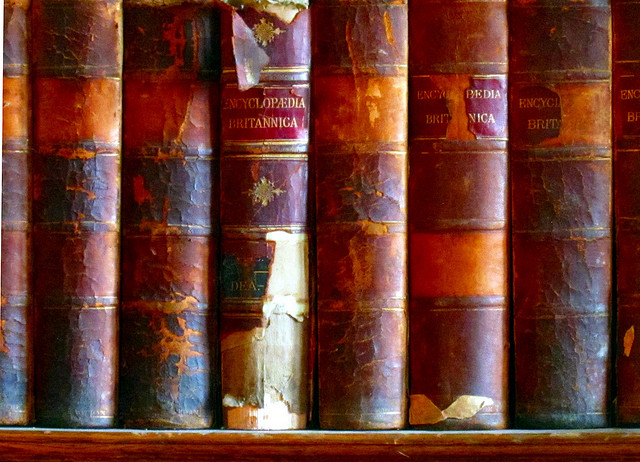
You’ve probably heard that after two hundred and forty-four years Encyclopedia Britannica is ending its print edition as it fully embraces the digital age. This is a sad moment for all book lovers, and a powerful indication of what is to come.
To celebrate all that Encyclopedia Britannica has meant to some of us, I’m reposting a story that features these great books. This was the very first post at Chubby Chatterbox back on August First of last year. Few people saw it. The only comment I received at the time suggested this didn’t really happen, but it did. The post is called (Terms And Limits).
Monday, August 1, 2011
Terms and Limits
I’m constantly amazed that daily conversations with my eighty-six year old mother have not caused me to turn to drugs or alcohol, although I often seek shelter in tension eating. Surprisingly, I still have a good head of hair—no bald patches from when I try to pull it out. Our conversations range from her revisionist memories to discussions about dead-beats in the family. But our most divisive topic of conversation is politics. My petite gray-haired mother puffs up like a venom-spitting cobra when she discusses the government, which she hates even though she’s benefited from several so-called “entitlement” programs. Anyone attempting to change her mind about government, or anything else, ends up struggling like a dog trying to squeeze a mastodon bone through a doggie door.
I’m reminded of a particular discussion we had in the ‘70s during my first visit home from college. I was cocky and desirous of showing off my new-found knowledge, and it didn’t take long for me and my mother to dive into politics.
She started affixing blame for America becoming a “welfare” state. “Franklin Delano Roosevelt is responsible,” she said, sneering like Archie Bunker. “He was president too long—ran three times!”
I tried to correct her. “Actually, he ran four times.”
We argued about it for an hour, with her unwilling to consider the possibility that she was wrong.
“I should know,” she spouted. “After all, I was there and you weren’t.”
I left in a huff and drove to the public library, where my mother was well-known for her rapid consumption of bodice-ripper romances and her inability to lower her voice. The librarian was sympathetic when I explained why I was there, and permitted me to check out an unimpeachable reference source to prove my mother wrong—a volume of Encyclopedia Britannica.

When I returned home with the volume, I opened it to the section on FDR and pointed to the line: FDR died in 1945, only a few months into his fourth term.
My mother glanced at the sentence, slammed the encyclopedia shut and said, “Oh my God…”
She was about to admit she was wrong about something. Hard to believe! As it turned out, I didn’t have to.
“I’d never have thought it,” she said, “a misprint in Encyclopedia Britannica!”
Subscribe to:
Posts (Atom)